
Celebrating Our Kessler Scholars
Kessler Kudos 2025

Laiba Mahmood
From Custom Major to PhD: How One Scholar Turned Passion into Purpose
Q: Tell us a little bit about yourself.
A: I double majored in environmental biology and geology through the CUNY BA program to design my own degree to have more of a foundation for graduate studies in planetary science and astrobiology. Because I’m a first gen college student, I’m super passionate about creating community and making resources more available to students.
Q: What led you to pursue your major?
A: I started undergrad as a regular bio major, but I quickly realized I didn’t have any direction for what I wanted to do after undergrad and that I didn’t have the motivation to push through difficult classes if I didn’t have a reason to take them.
That’s when I started referring back to why I wanted to study science, and it was always about trying to study planets and trying to study what makes Earth what it is, which is geology. I was looking through geology courses offered at Queen’s College which got me excited about my education, but I still liked biology, which is when I decided to do an interdisciplinary degree in making my own major.
Q: Can you tell us a little bit about how you want to make things more accessible for students as well?
A: I’ve noticed a lot of undergrad things, especially at Queen’s College, aren’t very STEM focused. If there is, it’s mainly studying focused. There hasn’t really been discussion about graduate school and how to apply. Sure, there’s info here and there about applying to internships and things like that, but they’re not really catered for research or catered towards STEM degrees. I recently got hired as the peer advisor for the School of Earth and Environmental Sciences, and I want to make resource guides and add information about getting scholarships, grad school applications, internship applications, how to find internships, and even studying abroad.
Q: Could you tell us a bit about your CUNY BA experience?
A: CUNY BA is a program where you create your own major with academic professors who overlook your degree and make sure the chosen courses are rigorous and related to your degree name. The process was just doing an online application and I heard back from them a few weeks after applying. CUNY BA definitely strengthens my portfolio as a student, because it shows that I took initiative over my major, especially in terms of finances because doing a double major and being a full-time major for two majors is just crazy. Also because what I’m trying to study is kind of niche, and so that’s why I did Cuny BA, but it’s been a good experience, for sure.
Q: Have you won any scholarships, internships, etc outside of school?
A: I won the Barry M. Goldwater scholarship earlier this year, which is a prestigious stem scholarship for students who were interested in applying for PhD programs and continuing research. I’ve done two internships through my undergrad degree.
My first one was a summer research opportunity program at the University of Michigan where I spent ten weeks doing work with bio geochemistry.
It was basically my first time doing actual research from the start to getting results. I had a really fun time.
The program is also very much related to Kessler. I went to dinner with other Kessler scholars from different campuses and met Gail Gibson, the founding executive director of the Kesler program, which was fun. I also did an internship with NASA this summer at Southwest Research Institute where I got to work on the Europa Clipper mission that launched last year. I’m continuing to work with that scientist this year, and that allows me to get more research experience in a field relevant to my interests.
Q: In what capacity are you working with this scientist?
A:
Over the summer, I was developing geochemical models for Europa’s ocean. Europa is one of Jupiter’s moons that NASA thinks if life were to exist in our solar system, that’s one of the more habitable regions. My research was basically developing models of the chemistry of the ocean to see what metabolic processes are possible for microbes that use chemistry to survive.
I’m continuing to do that, and I’m making it more accurate than what I did over the summer. Through CUNY BA, I got the Thomas W. Smith fellowship, which gave me $4,000 a semester as recognition for being an excellent student.
Q: What do you want to do after you graduate?
A: I’m applying for PhD programs that truly focus in planetary science and astrobiology.
I still have to talk to advisors and get projects sorted out, but it’s definitely something in the context of looking for if life is possible beyond Earth and looking at how habitability looks in our solar system.
Q: What is the best part of being in the Kessler Scholars Program?
A: Chrystle has been such a good support throughout undergrad.
She’s definitely seen my growth from being a freshman to now a senior. She gives you a bigger perspective if you have issues and knows who to contact and what to solve if you have an issue. She’s very on top of things, like, it won’t be, oh, just contact this person and like, whatever. You can walk in her office whenever and ask as many questions as you want. She’s super approachable, super informative and just super yeah, yeah.
Q: Do you have a most memorable moment from the Kessler Scholars Program?
A: The University of Michigan dinner. Meeting other Kesslers Scholars, meeting people who were in charge of Kessler, and learning more about the history of how and why the program started was one of the more memorable experiences of being a Kessler Scholar. Just getting to know people from other institutions that are also Kessler Scholars having that bond of similar backgrounds and going to academia and having this internship together and learning so much more about the program. That was a really nice experience and something not a lot of students get.
Q: How has being involved with the Kessler community shaped your experience as a student?
A:
It helps to help someone who understands what you’re going through, even if it’s not directly in science. Navigating higher ed in general is a challenge, especially if you don’t know what you’re doing or if you don’t have the background in it. It’s nice to have a community where it’s okay to ask questions, and Kesler has so many resources beyond Queen’s College that are very helpful.
Q: Do you have any advice for future Kessler students?
A: In terms of getting opportunities, it’s really important to write well, and I think it’s important to get people to read your essays and responses. That’s definitely one of the biggest factors of your application, I would say more important than GPA or anything like that. It’s important to put your best foot forward, even if you’re not confident. I would have never applied for the scholarships or the internships that I won, because I never thought I was good enough in terms of like my application is not perfect; why would they want a student from Queens College? Why would they want someone who is making their own degree? Like, for example, I applied for my NASA internship 30 minutes before it was due because I kept going back and forth saying, I’m never gonna get it; what’s the point of spending time putting together an application, like it’s so out of reach. Then I won, and it kind of taught me I should be giving myself more credit. Even for Goldwater, I wasn’t going to apply until my sister was just like, bro, just apply.
You never know. If you don’t win, whatever, if you win, great. And I was like, okay, fine, I’ll apply, and then I won it, and I think it’s just good to have more faith in yourself and just try to do things even if they seem impossible.
Bradley Gros
Bradley Gros — Style Meets Study: Building a Clothing Label While Earning a Degree
Q: Tell me a little bit about yourself.
A: My name is Bradley Gros, and my major is Computer Science. I’m a sophomore, and I graduate in Spring 2028. School is my number one priority. My future goal is a job in cybersecurity as a Security Analyst. My second passion is my clothing brand and things I put into it.
I really take passion in designing because everything on my clothing, I designed myself.
Q: How did you get interested in Computer Science and Cybersecurity?
A: In high school, I was doing engineering, and a little bit of coding.
Q: How did you get interested in your clothing brand?
A: I always wanted to start one. I’ve always been into fashion, even my brother, my family too. When I was in high school, I launched my first clothing brand in my sophomore year. It was a solo clothing brand. I didn’t really know what I was doing, and that was really my first time ever doing it, so it failed. Then, I came up with this one, and now I have a team. We’re still building day to day. It’s like having five jobs. We started in the very first month of the year, and we’re almost a year in. It’s going really well right now. Recently, we had Lance Stevenson purchase from our site. We’re five figures in right now, so, I can see it potentially getting to way more than that.
Q: What do you mean by it’s like having five jobs?
A: There’s a lot that goes into it. I have to work on the site. I have to work on the payments. I have to work on talking to the people [the manufacturers], cause whenever you’re searching for manufacturers, you have to do research on who you can use. You can’t just use anybody, quality matters. Whenever I send them samples, I have to figure out a measuring chart, how big I want stuff. Cause if you don’t tell them every detail, they could mess up. Like the shirt is more than just sending the design, I have to send what size I want, the type of wash, the color, cause they have numbers. Whenever you want a color, it’s numbers, so like Black 42. So, it’s a lot that goes into it, you know, sending off pieces, so it’s a lot more than just sending off the design.
Q: What was the name of the clothing brand you launched in your sophomore year?
A: Synsonic.
Q: Was there a reason why you chose that name?
A: My friend chose it for me, to be honest. I was supposed to do it [the business] with him, but he wasn’t really taking it seriously, so I just took over the whole thing. It was really hard, though, running it by myself. Like I got scammed out of like $600.
Q: By your friend?
A: No, no, no, by manufacturing.
Q: What was that experience like? Did you ever get your money back?
A: No, you can’t because they’re in [another country]. I ordered some beanies, and when I received the order, they were all kid sized, so they couldn’t even fit my head, even my little cousins head, and he was like 3 at the time, they barely fit his head. And you can’t get your money back, cause they already made it. Whenever they make stuff, before they can even start, we have to pay them so they can buy the fabric.
Q: Are there any precautions you have taken since then?
A: Whenever you’re dealing with people, you have to point out small details about them. Like, if you want to work with them on Instagram, you have to look at their following, cause sometimes people steal pictures from other manufacturers and post it on their page.
Q: What’s the name of your current clothing brand?
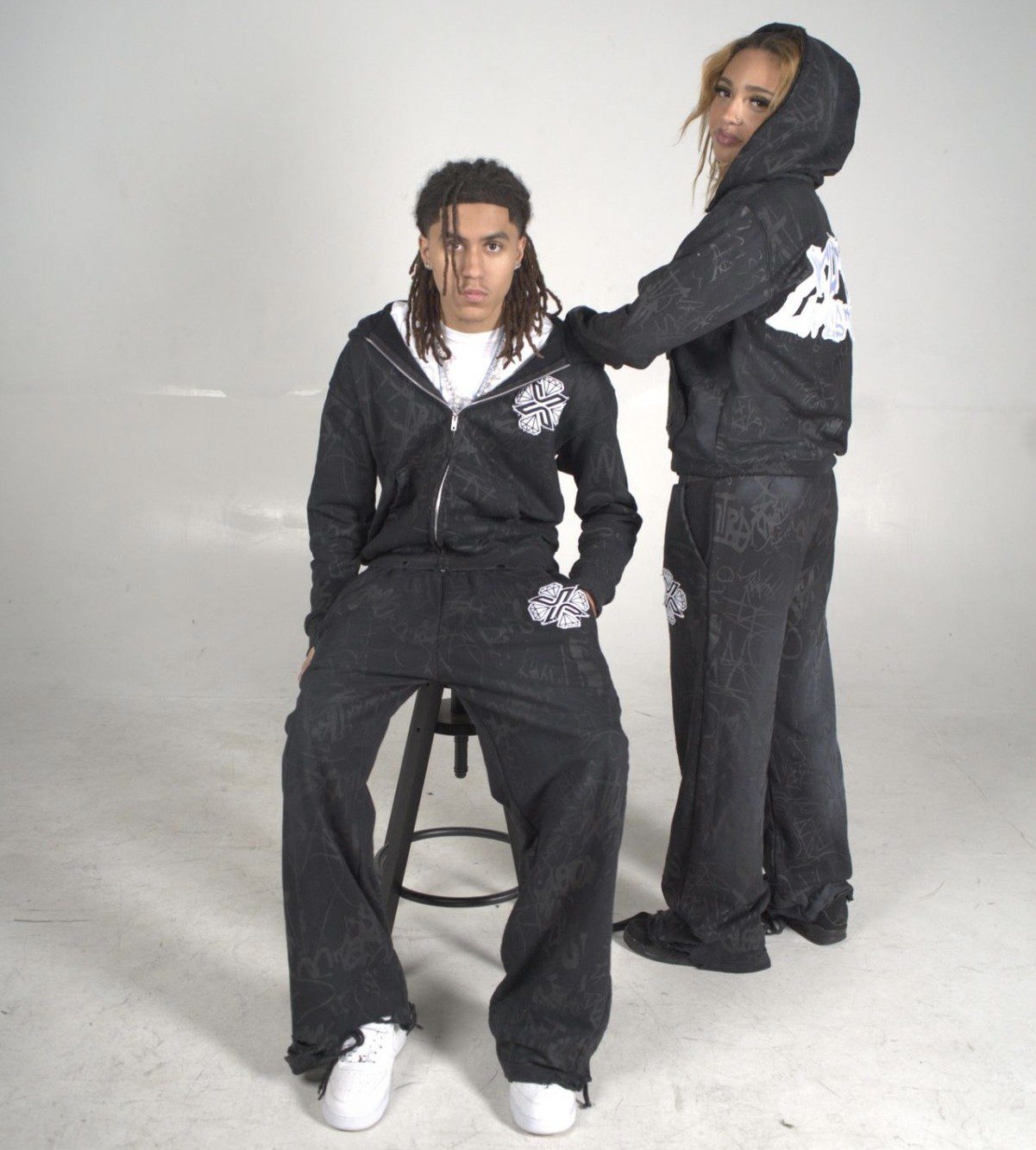
A: Xotic
Q: Looking at your website, I saw some new pant designs, bikinis, shirts. Is that what you guys make?
A: We sell everything. Like, we have beanies, pants, tracksuits, sweatsuits. We try to have different stuff for everybody to wear. Like, we have girls tank tops. We make a lot of girl stuff. We just made the Lululemon leggings. We’re tryna start our winter collection. We have a rhinestone sweatsuit, like our other one, but this one has pearls on it. A windbreaker, tracksuit, long sleeve shirt, pair of jeans, we just have stuff dropping.
Q: These are already out?
A: No, they’re getting made right now.
Q: Where do you draw your design inspiration from, and why did you choose that design specifically?
A: Honestly, when I design, I go for trendy things just so that it’ll sell better, but usually I get my inspiration from other brands. I just go for the streetwear brands, but we’re tryna transition to more designer high-fashion type of.
Q: Why?
A: We’re tryna start cornering the market to where we could make everybody want our clothes, like females, kids — we’re starting a kid collection — so females, kids, just like everybody could wear it, even the old people, make basic stuff for them, make streetwear stuff for them, people my age, our age. So we just try to make everybody able to buy.
Q: I remember you telling Chrystle about some modeling thing. Some company had asked you to model your clothes. Did anything come of that?
A: That was a college, UCONN (University of Connecticut). Basically, I have to bring 14 items for the models to wear, and they’re gonna have a big fashion show. It’s something they have every year, and they invited me.
Q: How did they get in touch with you?
A: From social media. Our Instagram just got banned, though. Our older one had 6,000 followers, but it got banned.
Q: Why?
A: Scamming. They said we were scamming because we were listing so many products at different prices. So, it detected it as scamming. When you do that [make a page] with Instagram, you basically have to set it up to where you have to tell them before you start. We finna get our other one back, though.
Q: Other than UCONN, have you had the chance to work with any other companies or brands?
A: Honestly, the biggest thing we’ve had was stores asking us to put our merch in there. Stores in Houston, streetwear stores, local stores. We had a store in LA contact us. We’re planning to open a store in the next three months in Houston, so we’re tryna get in the stores and spread our name around the area as much as possible.
Q: How would that run? Because you go to school and live in New York.
A: My team would work there.
Q: Who does your team consist of?
A: Me and three other people. I look at them like family. Like, I could trust them. You know, you don’t want to build a team with people you can’t trust.
Q: But you’re the business owner, right?
A: Yeah, it’s me and someone else.
Q: Do you have a favorite part of being a business owner?
A: Honestly, my favorite thing is seeing people wear the clothes that I make. Like, it’s inspirational. Cause whenever I’m looking at the clothes, it’s different from other people’s perspective, cause I’ve made it from nothing. Like, I’m looking at it like, I was in my room, like it was probably 2 AM, and I made it. So, it just fuels me to go harder and strive harder, because people actually like the stuff that I’m coming up with. It’s not like we’re just paying somebody to design, it’s coming from me, like my thoughts. That’s probably my favorite part, honestly. Also, like at a young age, I’m learning how to- say if I was ever to get a different business in the future, I would have, like, some sort of knowledge of how to run it.
Q: What’s the experience of being a young business owner while going to school been like for you?
A: It’s been a roller coaster, honestly.
It could sometimes be stressful, demotivating if things don’t go well. But at the same time, you learn a lot as a student and as a business owner at a young age. You learn a lot of things that can transfer to the real world, even in computer science, some of the stuff that we do can also transfer it to the real world.
Q: What kinds of things can you transfer over?
A: I can say the biggest thing is setbacks, like major setbacks. That could translate into anything, like school or real-world things, like with the business as well, cause like I said, the other thing, we recently had an order to where he brought us shirts, and they didn’t look nothing like the shirt that we made, so we already paid for it, and basically, we can’t do nothing. There’s just a loss. So, I say like real world example could be anything, like taking a loss. You know, you gonna learn how to bounce back from it, and I say that could, like, translate to the real world. Like, in a sense, take losses, and it’s what you do next that matters.
Q: I know that you did an internship at Deloitte University. Can you tell me a bit about that?
A: It was about accounting in the business side. We met four professional workers at Deloitte, and they basically just gave us advice on what to do for the next four steps. We met a lot of important people that contribute to Deloitte on a daily basis and they also introduced us to things around the campus, and it was just a great experience.
Q: Next four steps of what?
A: Well, basically, they were just saying like four steps of how to go about your next few years of college. And they was just giving us advice on how to like- just things you should do to where you won’t end up fall behind or you know, just take it serious. Like, giving us advice from what they’ve experienced that could help us potentially in the future.
Q: What has been the best part of being in the Kessler scholars program? Was there a memorable moment or event that you can think of?
A: I say contributing to the community and bonding with fellow peers. The first apple picking last semester. I liked that.
Q: Is there something that I haven’t asked you that you would like to share with other first gen students?
A: Don’t take things for granted because you’ll never know if you’ll be in this position again. So always take things seriously, don’t take nothing, when it comes to college, don’t take it as a joke or anything, because you only have four years, and it goes by fast.